LedisDB is a NoSQL database written in Go. It is similar to Redis and uses redis protocol. It can be used as a replacement of Redis. However, it uses RocksDB, LevelDB or goleveldb as storage engine. Therefore, unlike Redis, the storage is not limited by memory. The name LedisDB comes from Level-Redis-DB.[04][05]

- Website
- http://ledisdb.com[01]
- Source Code
- https://github.com/ledisdb/ledisdb[02]
- Developer
- Country of Origin
- CN
- Start Year
- 2014 [19]
- Project Type
- Open Source
- Written in
- Go
- Supported Languages
- C, Go, JavaScript, Lua, Python
- Inspired By
- SSDB
- Compatible With
- Redis
- License
- MIT License
LedisDB is a NoSQL database written in Go. It is similar to Redis and uses redis protocol. It can be used as a replacement of Redis. However, it uses RocksDB, LevelDB or goleveldb as storage engine. Therefore, unlike Redis, the storage is not limited by memory. The name LedisDB comes from Level-Redis-DB.[04][05]
History[06]
In 2014, Chinese programmer Siddon Tang noticed that as the number of users increases, the memory size is not enough for Redis. He found that SSDB could solve the problem. However, because of the three reasons below, he wanted to develop a database similar to SSDB using Go:
- Go development is quite rapid. Although the performance of Go is not as good as C++, it is great for rapid software development.
- He wanted to use LevelDB in his project and get some experience about LevelDB usage.
- He wanted to be more familiar with Redis.
Now, Siddon Tang is the Chief Engineer of PingCAP. He works on TiDB and TiKV. But LedisDB is still under his maintenance.
Checkpoints[07]
LedisDB uses RocksDB, LevelDB or goleveldb as storage engine and thus inherits their checkpoint mechanisms.
Compression[08][09]
LedisDB uses RocksDB, LevelDB or goleveldb as storage engine. You can enable their compression feature via configuration. Data and index blocks are compressed individually. User can choose from a list of supported compression algorithms, like LZ4 and Snappy. User can choose to use Dictionary Compression, too. Data are decompressed when LedisDB retrieves them from the underlying storage engine.
Concurrency Control[10]
There is no concurrency control protocol in LedisDB because it does not support transactions. Like Redis, LedisDB processes requests as commands. Each command is treated as a single atomic operation. However, LedisDB does not provide any mechanism to combine commands into transactions.
Data Model[11]
LedisDB is a key/value store, but has rich data structures. In addition to simple key/value pair, it provides Hash, List, Set, ZSet.
Indexes[07]
LedisDB uses RocksDB, LevelDB or goleveldb as storage engine and inherits their index data structure, which is the Log-Structured Merge Tree. They also use Skip List in the MemTable part.
Logging[07]
LedisDB uses RocksDB, LevelDB or goleveldb as storage engine and thus inherits their logging mechanisms. They log all Put operations.
Query Interface[11][10]
LedisDB can be embedded in Go programs and programs can use its API to perform queries. LedisDB also provides a query interface in redis protocol called RESP(REdis Serialization Protocol), and can be queried via redis-cli. LedisDB has HTTP API support, too.
Storage Architecture[07]
LedisDB uses RocksDB, LevelDB or goleveldb as storage engine and thus inherits their storage architecture. It also provides an option to use memory-backed storage (via goleveldb).
Storage Model[07]
LedisDB uses RocksDB, LevelDB or goleveldb as storage engine and thus inherits their storage model. Data are stored in the form of ordered key-value pairs.
Storage Organization[07]
LedisDB uses RocksDB, LevelDB or goleveldb as storage engine. Therefore, it inherits their Log-structured storage organization.
Stored Procedures[14]
LedisDB does not support stored procedures, but like Redis, it provides the capability to evaluate scripts using the bulit-in Lua interpreter. Scripts will be cached by LedisDB and can be invoked from the cache later. However, they are just cached rather than stored.
System Architecture[15][16][17][18]
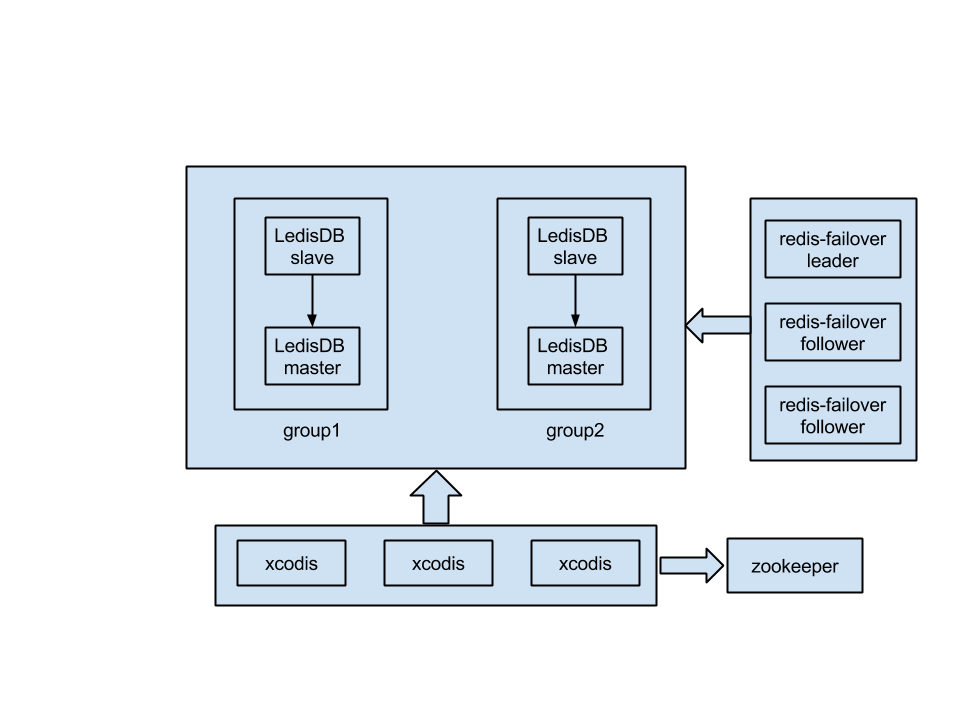
LedisDB can be embedded in Go programs. You can also run LedisDB as an independent server. Multiple LedisDB nodes and coordinator nodes can form a cluster with partition and Master-Replica replication. Each server does not share anything with others and only communicates with each other through network connection.





Citations
19 sources- LedisDB ledisdb.com
- GitHub - ledisdb/ledisdb: A high performance NoSQL Database Server powered by Go · GitHub github.com
- Home · ledisdb/ledisdb Wiki · GitHub github.com
- GitHub - ledisdb/ledisdb: A high performance NoSQL Database Server powered by Go · GitHub github.com
- 高性能nosql ledisdb设计与实现(1)_siddontang-CSDN博客 csdn.net
- 发布一个参考ssdb,用go实现的类似redis的高性能nosql:ledisdb_golang 类似redis-CSDN博客 csdn.net
- GitHub - ledisdb/ledisdb: A high performance NoSQL Database Server powered by Go · GitHub github.com
- ledisdb/etc/ledis.conf at master · ledisdb/ledisdb · GitHub github.com
- Compression · facebook/rocksdb Wiki · GitHub github.com
- Commands · ledisdb/ledisdb Wiki · GitHub github.com
- GitHub - ledisdb/ledisdb: A high performance NoSQL Database Server powered by Go · GitHub github.com
- ledisdb/ledis at master · ledisdb/ledisdb · GitHub github.com
- ledisdb/store/iterator.go at master · ledisdb/ledisdb · GitHub github.com
- Commands · ledisdb/ledisdb Wiki · GitHub github.com
- GitHub - ledisdb/ledisdb: A high performance NoSQL Database Server powered by Go · GitHub github.com
- GitHub - ledisdb/ledisdb: A high performance NoSQL Database Server powered by Go · GitHub github.com
- Replication · ledisdb/ledisdb Wiki · GitHub github.com
- https://medium.com/@siddontang/build-up-a-high-availability-distributed-key-value-store-b4e02bc46e9e medium.com
- Initial commit github.com